Audit and improve custom agent evals
Helping developers build the evaluations that make agents work.



We're working on making it easier for developers to create useful evaluations for their agents and understand where those evaluations fall short. Our work is being shared openly in the NeMo Eval Author project.
We think agentic evaluations are at the core of building good agents. They turn domain expertise and expectations into something we can test, tell us whether a change helps or hurts, and provide the feedback signal for optimization. If we're asking an agent to improve its own prompts, tools, or code, its evaluations help determine what "better" means. We want to make that feedback something developers can trust.
Our objective is to help developers (1) understand whether their agentic evals are "good" with respect to their agent and (2) create new evals as needed!
Doing this well across different agents and domains is still an open problem, and a big one at that. A coding agent, a customer-service agent, and an engineering design agent have different responsibilities, environments, and definitions of success. Generating evals for software as complex as modern AI agents is challenging along many axes.
We're therefore committed to working with the open-source community and building in public. Dev Notes is where we'll share our latest announcements, research, and lessons learned. Our latest work will be shared in our Eval Author research repo.
Creating Evals: Harder Than It Looks
Agents need evaluations, but many developers are new to building agentic evals and to evaluation science more broadly. Knowing that you need evals doesn't tell you how to build a useful set, or how to know when it's good enough. There's no clear, widely accepted metric that tells us how good an evaluation set is for a particular agent. Advice often comes down to trying things and seeing whether they work in practice. That matters, of course, but it leaves developers with a lot of trial and error just to get started. The process can feel more like an art than a science.
Much of the best expertise in evaluation goes into building large benchmarks. There's a lot to learn from that work, but the goals aren't quite the same. Research benchmarks typically aim to measure progress in machine learning and compare the capabilities of different systems. A team building an agent for its business has a more specific question: does our software work the way it's supposed to? Answering that means capturing the team's own workflows, expectations, and failure cases.
We think there's room to make this much easier. The tooling and guidance available today can make it hard to find a starting point and leave too much of the process feeling like magic. We want to help developers make concrete, informed decisions about their evals and build confidence in them as they go.
Introducing Eval Author
Eval Author is our test bed for exploring how to understand and create agentic evals. We want to bring together promising techniques for measuring and generating evals, try them on concrete case examples, and turn what we learn into tools developers can use.
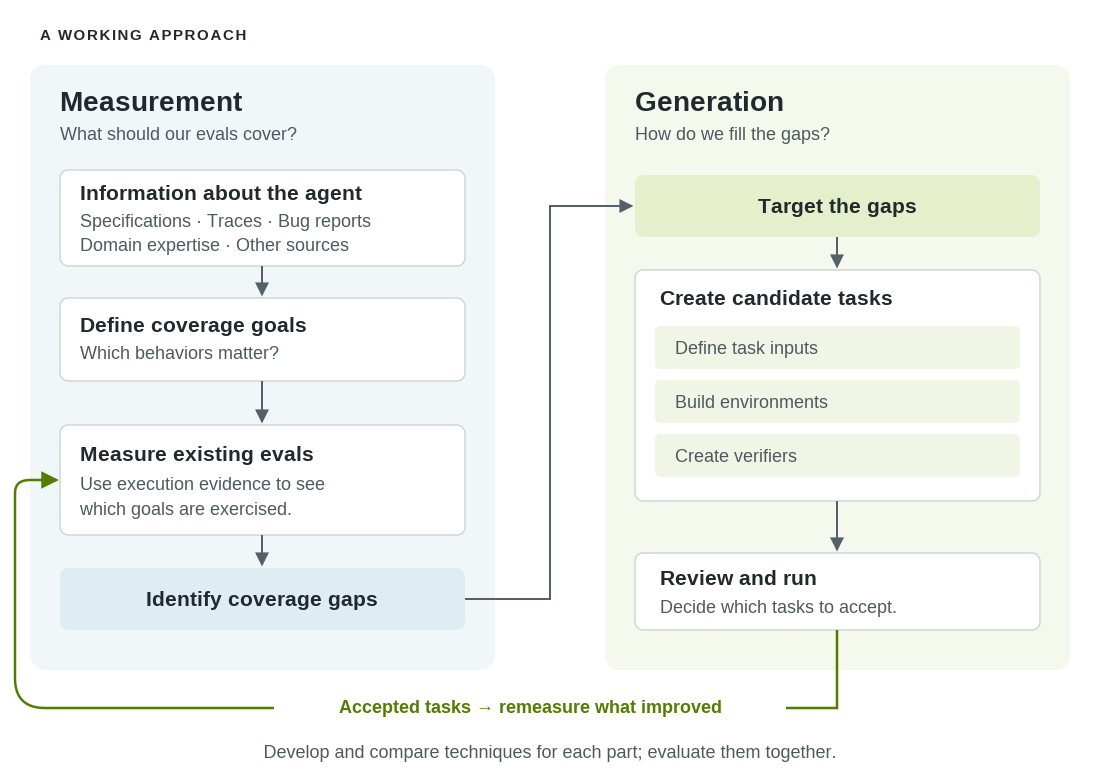
Understanding and generating agentic evals is a big problem, and we're therefore decomposing the work into a few connected problems: deciding what an evaluation set should cover; measuring how well it covers those goals; and generating tasks to fill the gaps. Each gives us something we can study and improve independently, then combine with the other pieces.
To learn whether these ideas work, we need good case examples: agents with meaningful work to do, environments where we can run them, and existing evaluations we trust enough to use as a reference. We also need variety. An approach that helps a coding agent might need something quite different to work for an engineering design agent.
We don't yet have the range of case examples or the benchmarks for eval generation that we'd like. Building that collection is part of the research, and a reason we're interested in working with teams who bring real agents, domain expertise, and evaluation problems of their own.
Breaking Down the Problem
Our working approach separates measurement from generation.
Measurement: What is "Good" Anyway?
The "goodness" of an agentic eval is an inherently squishy concept, but it should ultimately help answer the question: does this agent do what it should?
Different sources of information give us different views of what an agent should be doing. Specifications describe intended behavior, production traces show the work users actually ask it to do, and bug reports highlight where things go wrong. Domain expertise helps us interpret those sources and spot what's missing. Alongside that information, there are properties we'd want from any good eval set, such as accurate grading and realistic environments.
Our task is to turn this information into a set of goals. If we met all of them, we should have good reason to believe we'd built a useful evaluation set for the agent. We use coverage goals as a starting point, but the things we care about go beyond whether a particular behavior appears in a task.
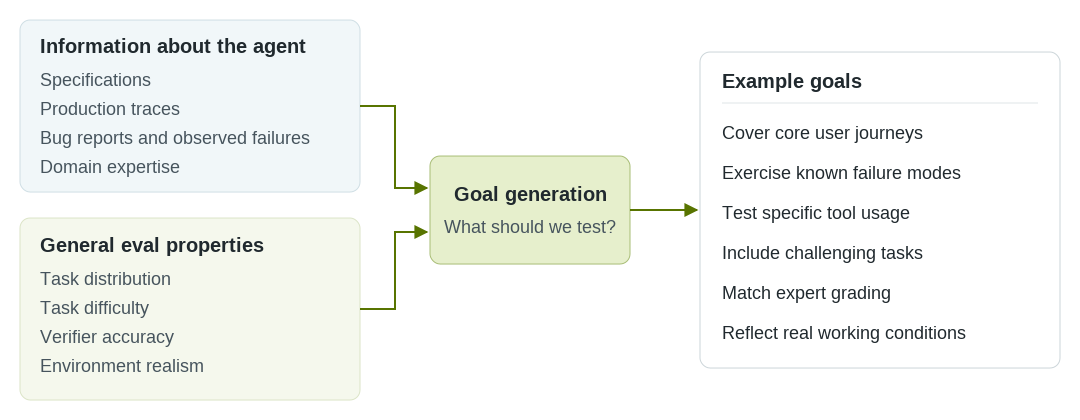
There are several properties we want these goals to encompass:
- Task distribution. Does the set cover core user journeys, edge cases, and known failures, informed by traces, specifications, and bug reports?
- Task difficulty. Are tasks challenging enough to guide improvement? Model laddering—comparing results across models with different capabilities—offers one possible signal.
- Accuracy of verifiers. Do the checks agree with domain experts about which solutions should pass or fail, including when a model does the grading?
- Environment realism. Do the tools, data, and starting conditions reflect real use? What counts as sufficiently realistic remains an open question.
The hard part is moving from subjective properties we'd like an eval set to have to things we can objectively measure. Some goals can be derived fairly directly from the available information; others need experiments or better definitions before we can measure them. Defining a goal and finding a trustworthy way to measure it are both part of the work. We need progress on both before a metric can tell us how good an evaluation set really is.
Generation: Turning Goals Into Evals
On the generation side, gaps against those goals give us a target. We can break task creation into three parts:
- Defining the input that asks the agent to do something
- Constructing the environment it will work in
- Creating the verifier that checks success
This is a tentative breakdown of task creation. There are plenty of things that make generation difficult, and we expect to discover more as we apply these techniques to different agents and domains. Some will deserve to be studied as problems in their own right. We want the breakdown to evolve with what we learn, giving us smaller problems we can tackle and improvements we can bring back into the overall process.
Each part needs to preserve what we set out to test. A task about recovering from a tool failure, for example, needs an environment where that failure can happen and a verifier that checks whether the agent recovered successfully. We then review and run candidate tasks, returning accepted tasks to measurement to see what improved.
One observation that initially motivated this work was how readily frontier coding agents took shortcuts while trying to make evaluations pass or achieve coverage. In our experiments, simply providing a detailed, carefully considered list of what an eval set should do hasn't reliably produced good evaluations. A task can run and pass while missing the behavior we wanted to test: an environment might reveal the answer, or a verifier might accept a shortcut. Breaking generation into smaller parts gives us places to look for these problems and test ways to address them. Understanding which checks we can automate is part of making the approach useful.
Just Getting Started
This is a starting approach for our work. It gives new approaches a place to fit: we can try a different source of coverage information, a new metric, or another technique for building environments without rebuilding all the tooling. We can work on each problem independently, then evaluate the impact of each piece individually, eventually identifying the most effective combined approach against our case examples.
Our current implementation is focused on spec-based coverage, where we define the behavior of the agent in semi-formal language and then generate coverage goals against this specification. Generation then produces Harbor tasks, leveraging existing coding agent CLIs to build the evaluation. Initial results are promising, demonstrating that Eval Author, for the small number of case examples we've tested it against, outperforms a raw, unguided coding agent. We plan to expand our studies and share these results in a future dev note. Our initial implementation is available in the repository.
A friendly warning: It's early! The experiments we run indicate that this is useful, more useful than just a standard coding agent, but don't YOLO with a coding agent and expect magic. Treat it as a guide to accelerate your work to get to a better outcome. And if you have suggestions, thoughts, or potential improvements, please share!
Parting notes
We're just getting started. These dev notes are where we'll share our experiments, the case examples we're building, and the lessons we learn along the way. If you're building agents and wrestling with how to evaluate them, we'd like to hear from you.