Stage Router
Execution routing uses the stage router to choose a model from tool results
and agent progress. Configure it with type = "stage_router".
Stage-router routing sends each request to either a capable model or a
typically cheaper efficient one, depending on where the agent is in its run.
The goal is to spend the capable model on turns that need exploration or error
recovery and let the efficient model carry routine, mechanical work. Choose a
required picker for ambiguous turns, tune the split with
confidence_threshold, and optionally add an LLM classifier.
Model-call fallback happens after the routing decision. Eligible context-window or availability failures can try the route's other completion target. See Context-Window Handling.
How it works
A tool-using agent's run moves through stages that call for different amounts of model capability. The built-in vocabulary is calibrated for coding agents: it recognizes file observation, mutation, planning, shell activity, and test results.
For each LLM call, stage-router estimates the agent's state from the conversation's tool-result history, scoring signals in two directions:
- RECOVERY → capable:
severity(windowed error severity),spinning(deep churn with no reads or writes), andexploring(reading or planning without producing) push toward the capable tier. - PROGRESS → efficient:
production_intensity(the share of recent recognized operations that are writes or edits) pushes toward the efficient tier.
The axes are corroborative: the signed score is tanh-squashed to a
confidence in [0, 1]. One maxed scoring dimension produces about 0.46;
corroborating evidence pushes confidence decisively past a 0.5 threshold.
Repeated failures, critical-error severity, and context compaction are hard
overrides to the capable tier. An active capable hold also bypasses the scorer.
Severity and test results come from tool output that ran something. The contents
returned by the built-in read and search tools do not count, unless the tool
reports a failure.
confidence_threshold sets how sure that estimate must be before the router acts
on the signal alone. Scores inside the ambiguous band go to the optional
classifier and then, if it cannot decide, to the picker's default tier. A turn
with no tool-result history follows the same fallback path.
The routing decision for one turn:
%%{init: {"flowchart": {"curve": "linear", "nodeSpacing": 36, "rankSpacing": 38}}}%%
flowchart TB
    start(["New turn"])
    history[/"Read tool-result history"/]
    recovery{"Hard recovery signal<br/>or capable hold?"}
    scorer["Compute signed tool-signal score"]
    band{"Outside the<br/>ambiguous band?"}
    classifier{"Usable classifier verdict?"}
    capable(["Route to CAPABLE"])
    signalRoute(["Route by score sign<br/>negative → efficient · positive → capable"])
    classifierRoute(["Route by classifier verdict"])
    defaultRoute(["Route to picker default"])

    start --> history
    history --> recovery
    recovery -->|Yes| capable
    recovery -->|No| scorer
    scorer --> band
    band -->|Yes| signalRoute
    band -->|No · ambiguous| classifier
    classifier -->|Yes| classifierRoute
    classifier -->|No · absent or invalid| defaultRoute

    classDef input fill:#e0f2fe,stroke:#0284c7,color:#0c4a6e,stroke-width:2px;
    classDef process fill:#f8fafc,stroke:#64748b,color:#1e293b,stroke-width:1.5px;
    classDef decision fill:#fef3c7,stroke:#d97706,color:#78350f,stroke-width:2px;
    classDef capable fill:#ede9fe,stroke:#7c3aed,color:#4c1d95,stroke-width:3px;
    classDef outcome fill:#dcfce7,stroke:#16a34a,color:#14532d,stroke-width:2px;

    class start,history input;
    class scorer process;
    class recovery,band,classifier decision;
    class capable capable;
    class signalRoute,classifierRoute,defaultRoute outcome;
After a signal-driven capable decision, capable_hold_turns keeps recovery turns
on that tier for up to two requests by default. A clean passing test clears the
hold early. Set the value to 0 to disable it.
Pickers
The picker name says which tier is the default: the tier used when the signals are ambiguous and no classifier verdict is available.
efficient_first: efficient is the default; escalate to capable only when the signals (or the classifier) clearly say so. Cost-first.capable_first(experimental): capable is the default; drop to efficient only when the signals (or the classifier) clearly say so. Quality-first.
Both pickers read the same signals; only the default tier differs.
capable_first is experimental
Every published threshold and routing result comes from efficient_first
runs. capable_first works and the server accepts it, but it has not been
benchmarked, so there are no calibrated thresholds for it and no measured
accuracy or cost figures to set expectations against. The server logs a
warning at startup when a route selects it. Use efficient_first unless you
are running your own calibration.
Tuning confidence_threshold
The tool-signal scorer gives each turn a signed score in (-1, 1): negative
scores point to the efficient tier, positive scores point to the capable tier,
and the absolute value is the confidence. confidence_threshold creates a
closed ambiguous band from -threshold to +threshold. Scores outside the
band make a signal-based decision; scores inside it go to the optional
classifier or fall back to the picker's default tier.
The TOML schema requires you to choose picker explicitly; there is no implicit
default.
Set 0.5 explicitly. confidence_threshold is required by the TOML schema;
0.5 is the recommended starting point, derived from many coding benchmarks,
and what the example below uses.
What 0.5 means with efficient_first
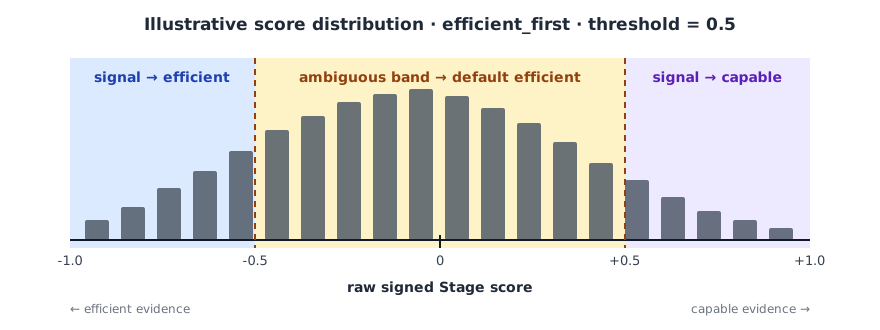
With picker = "efficient_first", no classifier, and a threshold of 0.5:
- scores below
-0.5route to efficient from the tool signals; - scores from
-0.5through+0.5are ambiguous and fall back to efficient; - scores above
+0.5route to capable from the tool signals.
Hard overrides and capable-hold state can still select capable independently of this score. Lowering the threshold narrows the ambiguous band, so more turns are decided directly by the scorer. Raising it widens the band, so more turns use the picker default (or the classifier, when configured). That movement changes the efficient/capable routing split.
confidence_threshold |
Behavior | Typical use |
|---|---|---|
0.0 |
Every non-zero score makes a signal-based decision. A neutral score or missing tool history still falls through. | Maximize decisions by the tool-signal scorer. |
0.5 |
Scores from -0.5 through +0.5 are ambiguous. |
Recommended starting point, derived from many coding benchmarks. |
1.0 |
Every ordinary score is ambiguous; hard overrides and capable holds still apply. | Classifier-driven when a classifier is configured; picker-driven otherwise. |
A route with a 1.0 threshold remains valid without a classifier. In that case,
ordinary sub-threshold turns fall back to the picker's default tier; hard
overrides and capable-hold behavior still apply.
The signal-vs-classifier split is dataset-dependent. Measure it in production:
/v1/stats reports decision counts by source and selected target, plus aggregate
scorer metrics. Response headers and structured decision logs explain individual
selections.
Calibrating the threshold from run data
Use about 10% of your representative tasks. Replay their agent histories through the Stage tool-signal scorer and collect the unthresholded signed score for each ordinary turn. Track hard overrides and capable holds separately because changing the threshold does not affect them. Plot the score distribution, then overlay candidate ambiguous bands.
For efficient_first, count how many turns fall below the band, inside it, and
above it. Without a classifier, those regions map to signal-selected efficient,
default-efficient, and signal-selected capable decisions. Choose the threshold
that gives the routing split you want, then validate it on the same sample before
running the full task set.
Route configuration
schema_version = 1

[llm_clients.openrouter]
format = "openai_chat"
base_url = "https://openrouter.ai/api/v1"
api_key_env = "OPENROUTER_API_KEY"

[targets.capable]
id = "openai/gpt-4o"
llm_client = "openrouter"
# system_prompt = "diagnose before you edit"  # optional

[targets.efficient]
id = "openai/gpt-4o-mini"
llm_client = "openrouter"
# system_prompt = "follow the settled plan"  # optional

[routes.stage]
id = "switchyard/stage"
type = "stage_router"
capable_target = "capable"
efficient_target = "efficient"
picker = "efficient_first"
confidence_threshold = 0.5
recent_turn_window = 3          # optional, defaults to 3
capable_hold_turns = 2          # optional, defaults to 2
Save as routes.toml and start the server:
This is the recommended default: routing on tool signals alone, no classifier.
Optional: custom tool semantics
Extend the built-in coding vocabulary when an agent uses domain-specific tool names. Mappings are route-scoped, additive, and matched by exact name without regard to ASCII case:
[routes.stage.tool_semantics]
observe = ["KB_search", "get_customer_by_phone"]
mutate = ["send_payment_request", "update_inventory"]
plan = ["create_research_plan"]
new = ["start_conversation", "send_message_to_user"]
The categories affect existing stage signals:
observecounts as investigation, like the built-in read and search tools.mutatecounts as production, like the built-in write and edit tools.plancounts as investigation, like the built-in planning tools.newrecords forward activity that suppresses falsespinningandexploringsignals, but does not otherwise favor either tier.- Unmatched tools remain
unknown; there is nounknownconfiguration key.
Configuration cannot reclassify a built-in tool. Empty names, duplicate names across categories, and unknown category keys are rejected when the route is loaded. Argument-aware wrapper tools, inferred semantics, and learned routing rules are outside this exact-name configuration.
MCP tools match by their bare tool name or by their full name. Claude Code sends
an MCP tool as mcp__<server>__<tool>, and Codex sends it with a separate
namespace. For both, send_payment_request matches the send_payment_request
tool on the billing MCP server, and so does
mcp__billing__send_payment_request. A server name that contains __ needs the
full name.
Optional: handoff notes
Add a [routes.stage.handoff_notes] section to append contextual guidance to a
request when tool signals decide its tier. Notes exist only in the forwarded
request; they do not accumulate in the caller's conversation. The escalation
note accompanies a signal-driven capable decision, and the optional de-escalation
note accompanies a signal-driven efficient decision.
[routes.stage.handoff_notes]
escalation_note = "the previous model was stalling; pick up the diagnosis"
# deescalation_note = "..."          # optional
# only_on_wrong_signal_escalation = true  # default; false also includes capable holds
Classifier and picker-default decisions do not add handoff notes.
Optional: LLM classifier fallback
The block is optional. Without it, an ambiguous turn goes directly to the
picker tier.
To judge ambiguous turns with a model call, add the block. The classifier runs when the scorer has no tool history or produces a score inside the closed ambiguous band:
[targets.stage_judge]
id = "openai/gpt-4o-mini"
llm_client = "openrouter"

[routes.stage.classifier]
target = "stage_judge"     # judge-only; never a completion destination
base_threshold = 0.5       # p_solve floor to route efficient; below this → capable
threshold_step = 0.1       # +0.1 for uncertain/unmatched; +0.2 for unsupported
recent_turn_window = 3     # trailing turns added to the opening task
prompt = "Estimate whether the efficient target can complete this request."
response_format_type = "json_object"  # optional; default is "json_schema"
prompt replaces the packaged capability-classifier prompt. In the default
json_schema mode, Switchyard sends the verdict schema through the
structured-output request. Set response_format_type = "json_object" for
providers that only support JSON Object mode; Switchyard then adds the schema to
the judge prompt and validates the returned object locally. The verdict schema
and routing thresholds remain unchanged.
The nested stage table in Composite Routing does not
accept a classifier block. Its outer classifier supplies the tier used when
the stage signals are ambiguous.
Give the classifier its own LLM client or quota bucket where possible. Sharing one provider bucket with the efficient tier adds a request per classified turn and can cause sustained 429s at scale.
Observability
When a model serves the request, the response identifies it with this routing header:
| Header | Content |
|---|---|
x-model-router-selected-model |
The model ID that served the response, including any model-call fallback. |
Decision sources
The router records an internal decision_source for each turn to distinguish the
paths through its cascade:
| Source | When |
|---|---|
override |
A repeated failure, critical-error severity, or context-compaction marker forced the capable tier. Structured logs set override_reason to repeated_failure, critical_error, or compaction. |
capable_hold |
A recent escalation kept this recovery turn on the capable tier. |
dimensions |
The signed score fell outside the ambiguous band and selected a tier. |
llm-classifier |
The signals were ambiguous and the classifier returned a usable verdict. |
fall_open |
The signal scorer abstained and the classifier was absent or could not decide, so the picker default was used. |
When not to use stage-router
- Single-model deployments. Use a
passthroughroute instead. - Probabilistic A/B splits. Use
Random Routing (
type = "random"). The stage-router's signals are wasted on a fixed traffic ratio. - No tool-result history. Stage-router needs meaningful tool-call traffic to populate its signals. For pure chat-completion workloads, the signal scorer abstains; the optional classifier decides, or the request uses the picker default when no classifier is configured.
Related
- Architecture: the end-to-end request lifecycle and system boundaries.
- TOML Schema: the complete configuration reference.