Speeding Up NeMo Safe Synthesizer Generation with Prompt-Aware Token Budgets
NeMo Safe Synthesizer has expanded to more models and larger context windows. That flexibility helps with longer rows, richer text columns, and time-series groups. However, it also exposed a generation bottleneck. Small jobs and short-row datasets could still pay for decode budgets sized for the full context window.
The updated generation path removes that waste in two places. It starts with a small prompt probe before scaling up the batch size, and it replaces full-context decode caps with prompt-aware caps empirically derived from token lengths of the actual data.
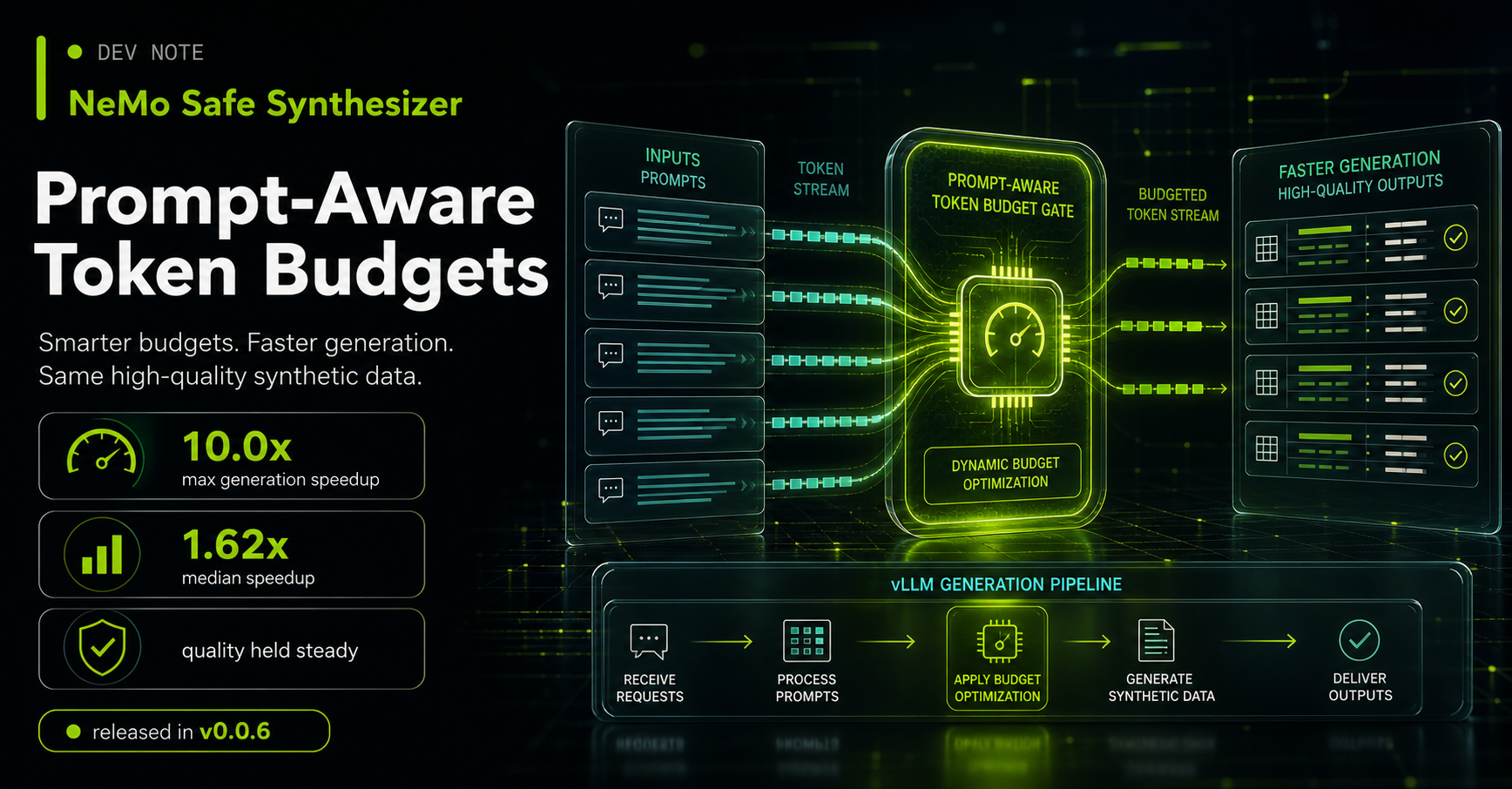
Our experiments show up to 10.0x generation speedup, a 1.62x median speedup across 39 before/after comparisons, and more consistent generation times overall.
This improvement shipped in NeMo Safe Synthesizer v0.0.6.
The Discovery
The first clear signal came from a small tabular generation job using the default target of 1,000 records. We only needed 1,000 synthetic records, but one run produced 7,871 valid records from 100 prompts. That was a 7.9x overshoot, and generation alone took over 5 minutes.
Inspecting the log exposed two related inefficiencies.
- Prompt-count: the first generation batch could be too large for small target jobs.
- Token-count: each completion had an oversized maximum decode length.
The prompt-count problem came from starting too aggressively. A Safe Synthesizer prompt can produce more than one valid record, and some datasets produce many records per prompt. If generation uses a full initial batch of prompts before measuring that yield, a small target can overshoot by several multiples.
The token-count problem came from the decode cap. For our default HuggingFaceTB/SmolLM3-3B model, the vLLM SamplingParams.max_tokens value was effectively 12,288 tokens. If a fine-tuned LoRA did not emit EOS promptly, vLLM could keep decoding until that full cap even when the model had only been trained to produce much shorter examples.
The new generation path addresses both pieces. The same case dropped to 1,097 valid records, 1.1x overshoot, and about 1 minute of generation time once generation used a small initial probe and a tighter token budget.
What Changed
Adaptive First Batch
Generation now starts with a 10-prompt probe to estimate how many valid records each prompt returns. After it observes actual valid records per prompt, it sizes future batches based on the remaining record target, plus a small buffer. The value 10 is intentionally small. It gives the generator a cheap yield estimate before larger batches, while explicit maximum prompt-batch settings are still honored.
Prompt-Aware Token Budget
During assembly, we track statistics about the number of tokens in each example. The maximum observed, max_tokens_per_example, is now persisted in the metadata from training, so we can use this to compute a more realistic token cap for generation.
The 1.2x multiplier is a safety margin around the largest tokenized example seen during training. The prompt-length clamp prevents decode requests where prompt_len + max_tokens would exceed the model's context window.
By using generation_cap_tokens for the vLLM sampling params, we restrict generation to completion lengths similar to the fine-tuning data, avoiding wasted time and tokens that are unlikely to be high quality.
Experiments and Results
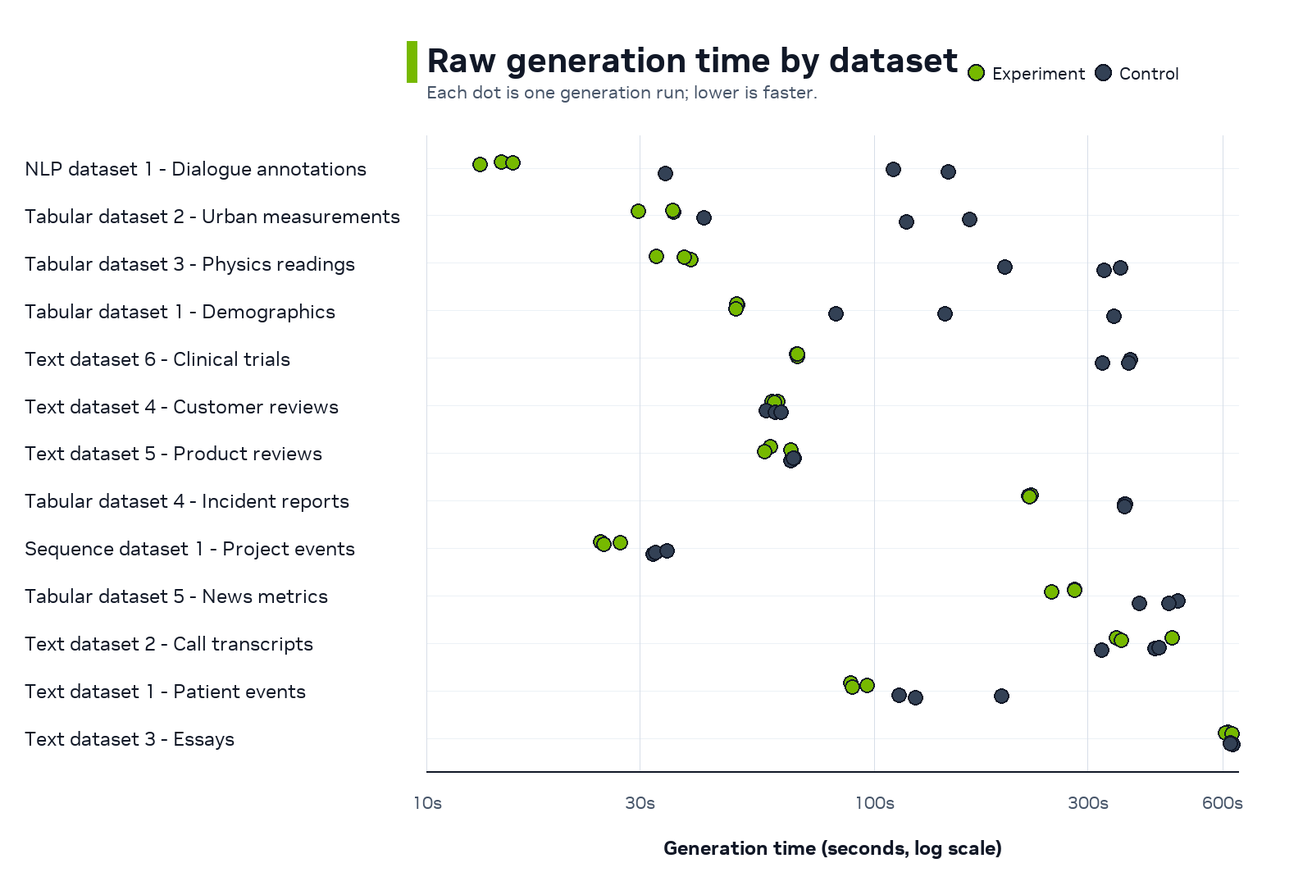
We compared the new generation path, the experiment arm, with the previous implementation, the control arm, across 13 benchmark datasets. We ran 3 replications for each dataset and arm, and focus our analysis on generation time.
The experiment used an NVIDIA H100 80GB GPU HBM3, the HuggingFaceTB/SmolLM3-3B model, and the vLLM generation backend (0.18.0) with a roughly 3,000-record generation target.
The speedup is not expected to be uniform across datasets. The implementation can only remove unneeded decode budget, so the generation cap should predict where the speedup appears. Datasets with much smaller prompt-aware caps should benefit the most. Datasets whose examples already use most of the context window should stay closer to parity.
Raw Time
The raw-time view shows absolute generation time for each control and experiment run. The experiment arm is often faster and more consistent, while the previous path can vary more within the same dataset.
Relative Speedup
The speedup view normalizes each comparison with this ratio.
Values greater than 1.0 mean the experiment arm was faster.
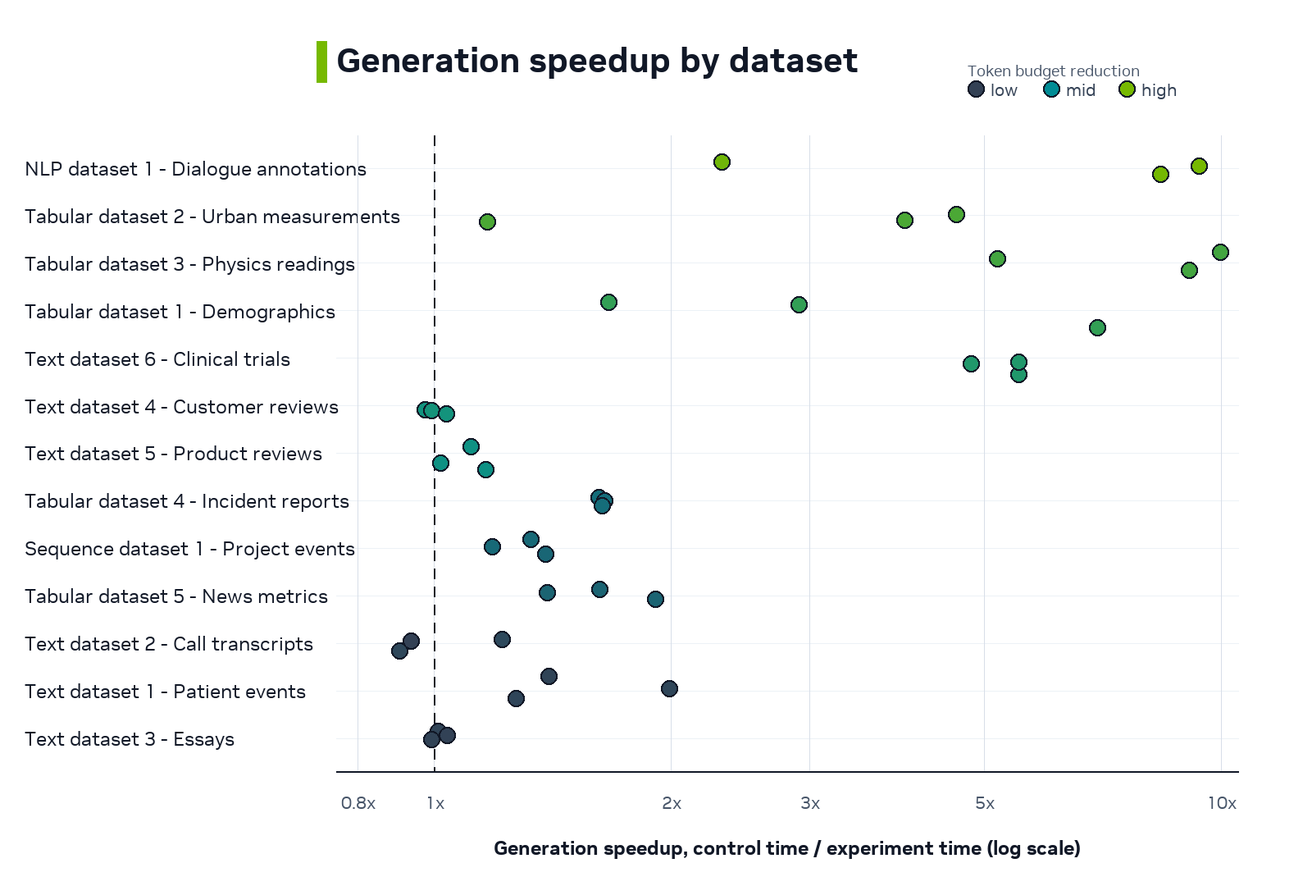
Both dataset charts are ordered by median prompt-aware generation cap, from smallest cap to largest cap. Each circle is one before/after comparison. Color shows the old-to-new token budget reduction factor. Low values mean the new cap stayed close to the old full-context cap. High values mean the implementation removed much more unused decode budget.
Why It Speeds Up
The main mechanism is token-budget reduction. The old generation cap was effectively the full 12,288-token context window. The new cap is based on the largest tokenized example that the assembler actually observed. Each run uses this ratio.
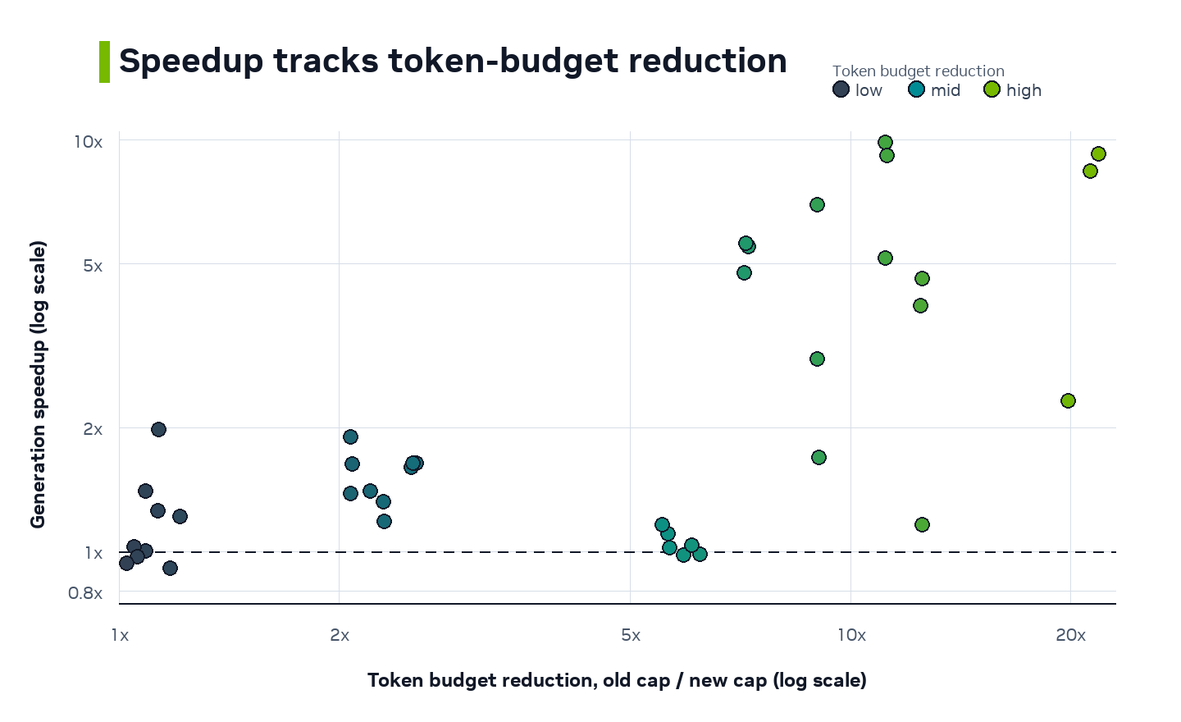
The result supports the expected mechanism. The largest generation speedups appear when the new implementation reduces the token budget the most. The previous generation path permits the full token ceiling on every dataset, while the new generation path adjusts the ceiling based on the dataset. That extra ceiling only becomes runtime cost when a completion keeps decoding toward it.
Quality and Validity Check
A generation-speed optimization is useful only if it does not trade away output quality or validity. Across these comparisons, quality and valid-record fraction stayed near parity overall.
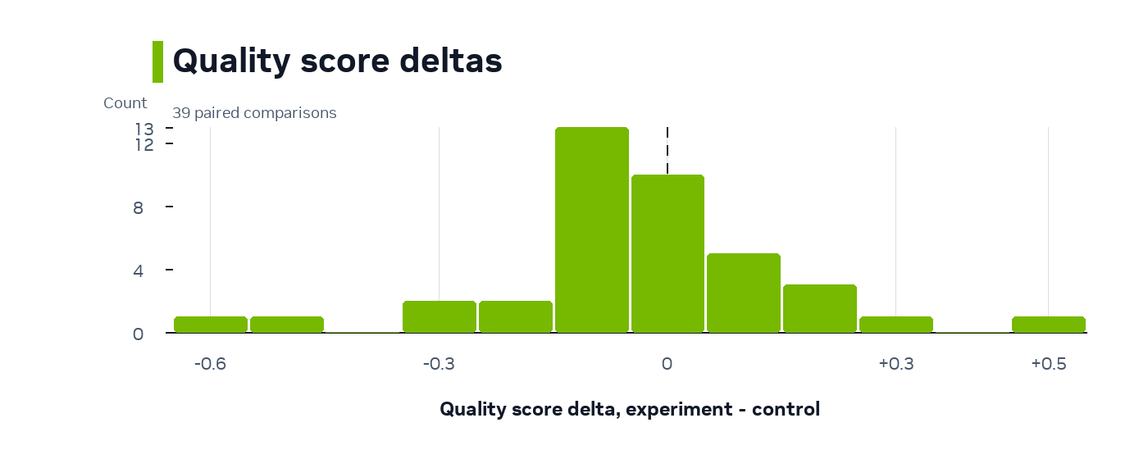
Synthetic Quality Score measures how well synthetic data matches the training data on a 10-point scale. The median quality delta was 0.0, and the middle 50% ranged from -0.1 to +0.05.
Valid-record fraction also stayed near parity. The median delta was +0.04 percentage points, and the middle 50% of comparisons stayed within about -0.43 to +0.84 percentage points.
Takeaways
The prompt-aware generation path makes NeMo Safe Synthesizer generation faster by removing two sources of waste.
- It starts with a small prompt probe, then sizes later prompt batches from observed records-per-prompt yield.
- It caps decode with assembler-observed token lengths instead of defaulting to the full context window.
Across 39 comparisons, the experiment shows up to 10.0x generation speedup and a 1.62x median generation speedup. The largest gains appear when the assembler-observed generation cap is far below the old 12,288-token context cap.
This improvement is included in NeMo Safe Synthesizer v0.0.6 and later.